

 Written by
 “This Is F****ing Fantastic!”
That was the opening line of a recent phone call with a client. I burst out laughing because I’d never heard her use language considered risque for work. But I got it; she loved it, and hearing it excited me, too.
Why was she so happy? I’d helped craft a new presentation that told the story of her business. Her industry is considered ‘dry’ or ‘technical,’ so many people struggle to see the human impact behind the services offered. By weaving a relatable narrative into the presentation, she could finally communicate the actual value of her work.
Seeing how well it resonated, she exclaimed, “This is ******* fantastic!” That emotional response told me we’d nailed it. But why did it work so well?
The Power of Emotional Storytelling
We’re hardwired to pay attention when an emotional context is involved. Whether it’s curiosity, excitement, fear, or relief, tapping into emotion wakes up parts of the brain that help us understand and care about the information.
Why It Matters in ‘Dry’ or ‘Complex’ Topics
Let’s say you work in cyber security – a critical field that can seem dry to the uninitiated. You might think, “How do I get people to listen to this? It’s important, but the details are technical or boring.”
The answer is to connect those technical details to a real, human-centred story. By showing what’s at stake emotionally, you make it impossible for people to ignore the message. Numbers and statistics might demonstrate the scale of a security threat. Still, a compelling story reveals its impact, which motivates change.
A Cyber Security Case in Point
Imagine you’re telling colleagues why multi-factor authentication (MFA) is vital. You could list its features: “It provides an extra layer of security, requires users to verify themselves, etc.” This is all true, but it might go in one ear and out the other.
Tell them an emotional story:
The accounts officer opened an urgent email signed by a senior partner. But something about the request didn’t feel right. They wanted her to transfer a large sum to an account she’d never seen. Her thoughts were racing: Could the partner be mistaken? This feels so off.
She dialled the partner’s direct line to ask for clarification. The partner’s shocked reply—”I never sent that email!”—confirmed her worst fear. Within minutes, the company leapt into action, shutting down the network, forcing everyone offline, and calling the IT service provider. Anxiety soared as they learned the partner’s inbox had been hacked, exposing the entire business to a malicious attack.
The crisis spurred immediate changes. The IT services provider upgraded its security protocols and introduced multi-factor authentication (MFA) seven years before their competitors. For the sake of this business’s clients, it was essential to never have intruders in their systems again. What began as a morning of dread and confusion ended with relief and renewed confidence in the measures to protect it from future threats.
Focusing on the confusion, the moment of fear, and the relief of catching the fraud in time shows the emotional stakes. When your audience feels the danger, they understand, on a deeper level, why MFA is so important. That story is far more memorable than a slide of bullet points.
The Science Behind Emotional Engagement
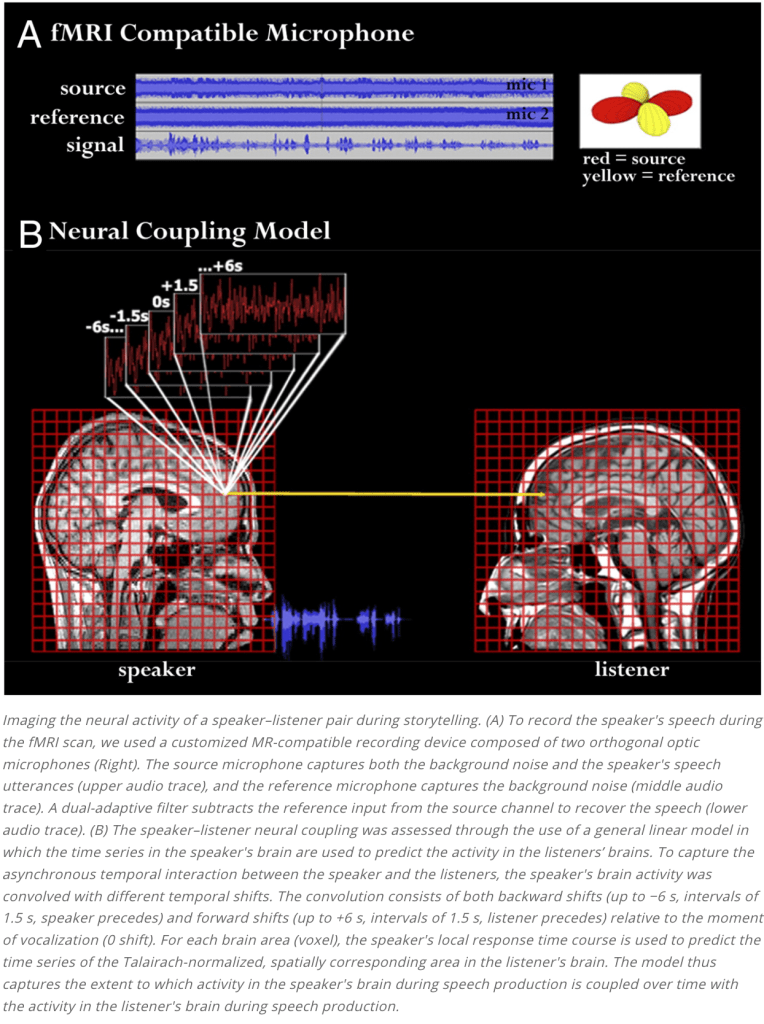
According to research by Professor Uri Hasson of Princeton University, when we listen to an emotional story, our brain waves synchronise with the storyteller’s. In his experiments, the greater the listener’s comprehension, the more closely their brain activity mirrored the speaker’s.
Brain regions responsible for complex information processing (like understanding motives and predicting outcomes) light up, creating a shared emotional and mental space. Essentially, the listener’s brain “lines up” with the storyteller’s, helping them grasp the more profound meaning.
Other scientists have found that when we read or hear a story, our brains also engage networks that decipher other people’s motives. This helps us predict what happens next and see situations from different perspectives. According to these studies, readers can even experience shifts in their core beliefs after immersing themselves in a powerful story and returning to ‘real life.’
I find this incredible! Reading written stories wires our brains to feel emotions that are baked into words. So, emotionally written content is just as effective in getting our audience hooked.
Emotion In Business
How do you incorporate emotional weight in your communication without feeling unprofessional? Here are a few tips:
- Use Real Examples: Share case studies or anecdotes that highlight human stakes. Whether it’s a project that went wrong or a new product launch that changed a customer’s life, focus on how people felt at each stage.
- Set the Scene: Provide enough context and detail so your audience can imagine themselves in the situation. The atmosphere and setting bring the facts to life.
- Highlight Conflict and Resolution: Every good story has a problem that needs solving. Show the tension, the risk, and the positive outcome (or the cautionary lesson if things go badly).
- Speak Authentically: Let some of your responses come through. If something truly excites or worries you, share that emotion. A sincere tone can be more persuasive than a purely formal one.
Conclusion: Stories Stick, Facts Fade
It’s not that facts and data aren’t necessary. They are. But facts on their own can be confusing or boring without context. When you attach emotion to a message, you turn those facts into something felt.
Emotional storytelling in professional communication is not about ‘losing control’ or being unprofessional – it’s about resonating with your message. By sharing stories that reveal why something matters, you’ll draw listeners in, clarify complex information, and help people remember what you’ve said long after you’ve finished talking.
So the next time you’re told to “keep it purely factual,” remember that the human brain craves stories and the emotions they carry. Blend data with feeling, and watch your audience say, “This is ******* fantastic!”
By allowing emotion into our presentations, reports, and everyday interactions, we stand a far better chance of connecting meaningfully and engaging effectively with audiences.
References / Further Reading
- Hasson, U., et al. (Princeton University). Research on brain wave synchronisation during storytelling.
- Neeley, T. (Study cited how reading and storytelling can shift core beliefs).
 Narrative Strategy and Storytelling for Organisations