
 Written by
 On storytelling frameworks, a Hollywood sequel, and the thing that actually makes stories good.
Think of the last movie you saw that made you cry. Or gave you a moment of validation or taught you something new. That moment in the film felt validating and real because a truth resonated with you. Let’s dive into what makes stories stick with you. I am going to talk about two components of storytelling. Structure and meaning.
Let’s start our exploration with the film, The Devil Wears Prada 2. It is part of the sequel rollout that Hollywood loves to do. Meryl Streep and Anne Hathaway reprise their iconic roles. The same director and writer take us to meet the characters twenty years later, and we see how their story continues.
The original film was iconic because it had a fabulous cast and fashion. And it had a timeless message, ‘the price of ambition is high’. Andy Sachs loses herself to succeed in this demanding environment, suggesting that to succeed in this world, one must adopt its cold, materialistic values. That was as true 20 years ago as it is now. Not just for fashion assistants in Manhattan. This is for anyone who has ever changed themselves to achieve another level of status.
The sequel is about the decline of print media and a power struggle over advertising dollars. The structure of the film is a precise parallel of the first. It follows a classic three-act arc that wraps up nicely.
It looks at modern work pressures around algorithms, human craft and creativity. But it has nothing new to tell you about ambition. This film, while delightful, is not a massive shift from the first.
Why was the first such a success? The structure of that film would have been the same as every other major Hollywood film that year. What made it stand out was its message. It has something honest to say. Before we go any further, at this point, everything is a sequel. There is very little that is truly new under the sun.
The real question is not about getting the structure right. Both the original and the sequel nail the three-act story structure. It is about how you reveal what makes your particular window into the world feel both startlingly personal and deeply relatable to everyone else.
Your experience is not unique. People have been falling in love, struggling with money, and chasing ambitions, since well, forever. What makes your story interesting are the quirks. The details that are so small and specific, they belong only to you. Paradoxically, the personal is the universal. The sharper your point of view, the more room there is for an audience to climb inside of it. You might never be a fashion assistant in Manhattan, but you know exactly what it feels like to trade a piece of yourself for a seat at the table. That truth is what makes your audience take notice. And want more, so they will buy a ticket for the sequel, read the next book, or watch the next episode. You get the picture.
The Structures
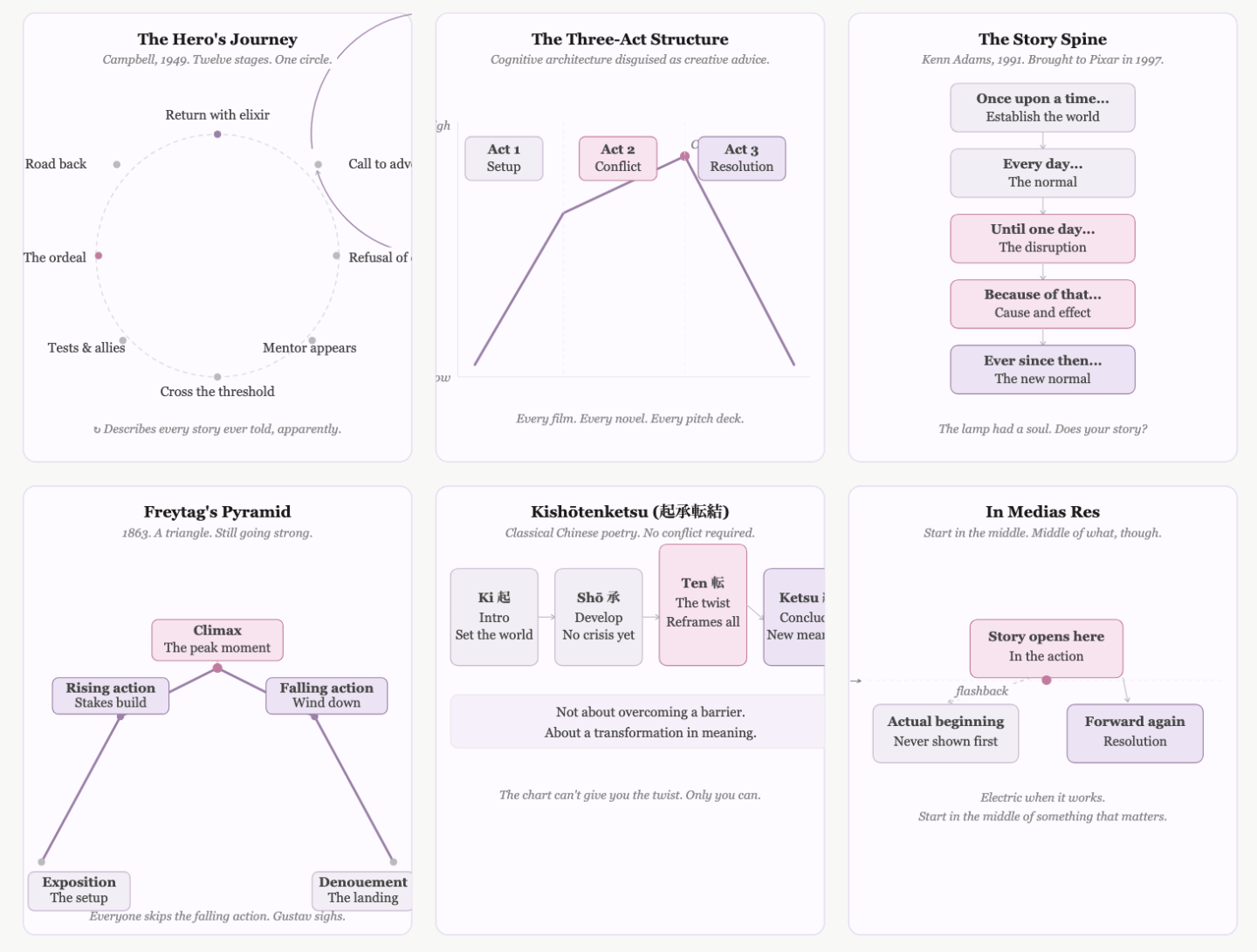
At some point, someone decided the problem that needed to be solved with business storytelling was that the teller did not have the right shape or structure. Once we got the structure right, our stories would land. This has given birth to the dirge of diagrams I see in storytelling books, LinkedIn posts and slide decks in storytelling workshops.
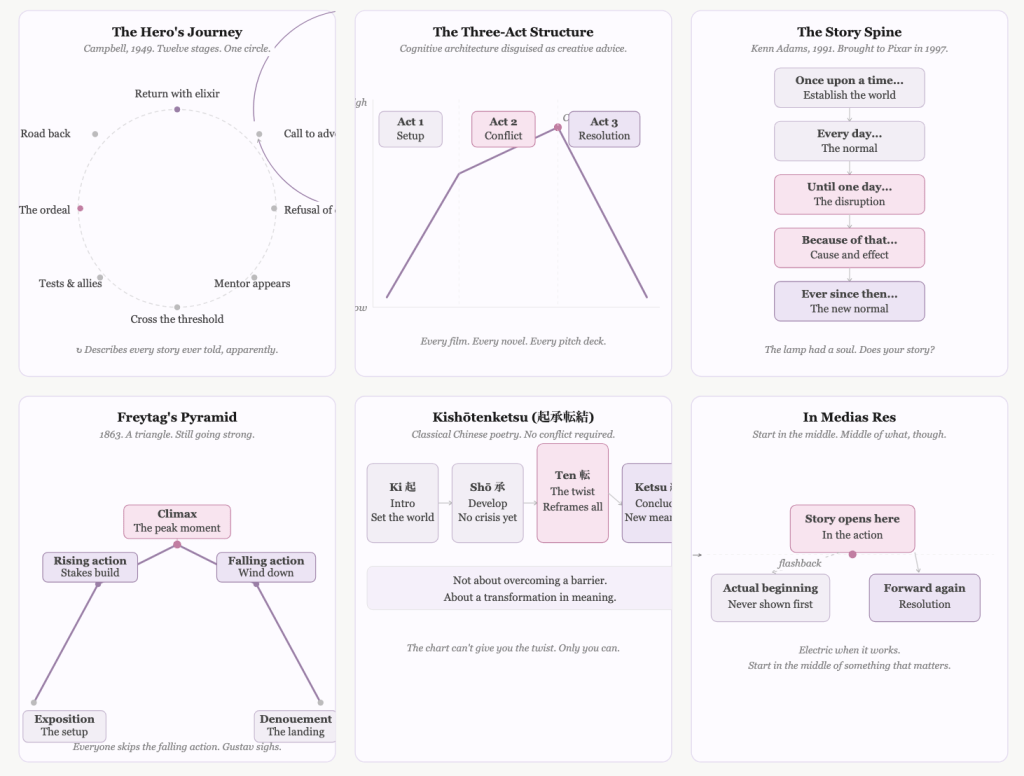
That isn’t to say these diagrams aren’t useful. Having a framework to lay your story out in makes it easier to get it out of your head and onto the page. I have my own story shapes I use in workshops. But this always comes after the most critical part of the training, creating the message. I will get into that a bit later.
For now, let’s examine a few common story structures and how to use them.
The Hero’s Journey
The oft-repeated and loved by film executives and business storytelling courses around the globe. Twelve stages wrap around a circle. Joseph Campbell spent a career studying mythology across cultures and made a claim that there is a mono-myth. A pattern that shows up everywhere from ancient Sumerian tablets to Star Wars. The human brain is wired for transformation narratives. We root for the person who is tested, broken, and remade. The Hero’s Journey gives you a scaffolding for an arc that has roots in Western storytelling for 1000’s of years.
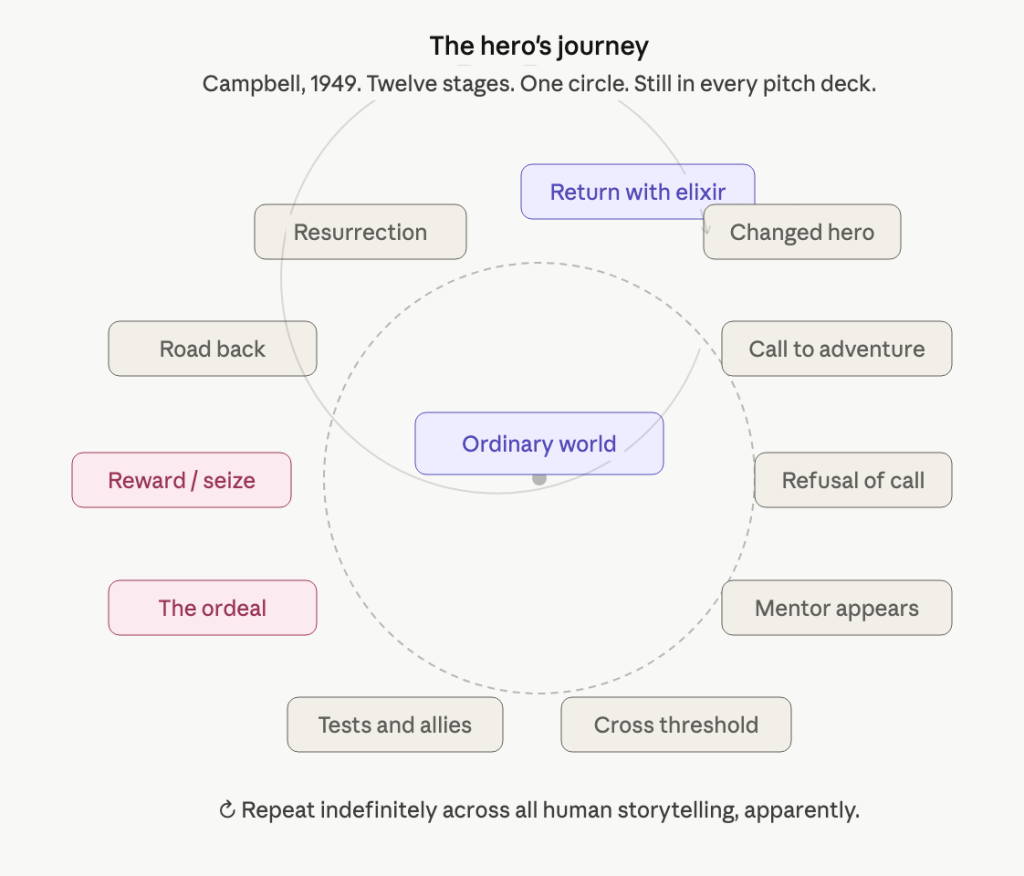
This framework is not one that I teach; it is heavily rooted in Western thinking, and it does not represent storytelling structures universally across cultures and time. It focuses on a ‘Hero’ who overcomes challenges and becomes someone else by the end of the story.
The Three-Act Structure
The setup leads to rising conflict and ends with resolution. This is how our brains process cause and effect. We need to know who we are following, what they want, and whether they get it. The three-act structure is a reflection of our cognitive architecture. It maps how our brains make sense of our experience, putting together the actions that lead us to where we are.
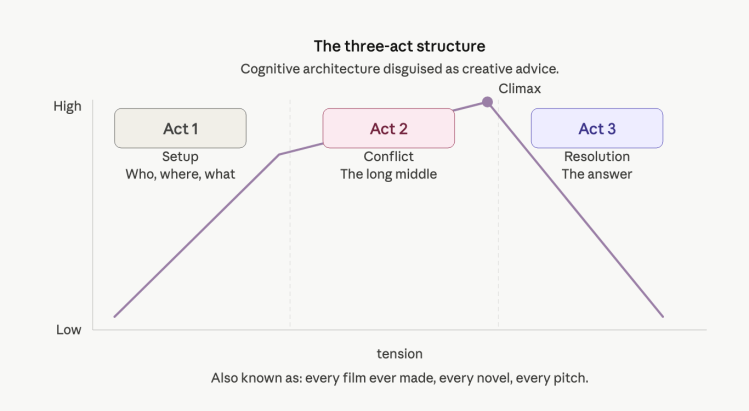
Often attributed to Gustav Freytag, who drew a slightly more elaborate version of this in 1863, added rising action and falling action, and then named a pyramid after himself. This is a core foundation to teaching storytelling and has been presented in workshops ever since. Gustav did a great job illustrating this structure, but I digress; let’s move on.
The Story Spine
Once upon a time. Every day. Until one day. Because of that. Ever since then. This structure is attributed to Pixar, which used this in their story room. However, this structure was actually created by improv teacher Kenn Adams around 1991. It reached Pixar when Rebecca Stockley, who had learned it from Adams, brought it to their story room in 1997. Pixar got all the credit. Kenn Adams got a footnote.
The brilliance of this structure is that “until one day” forces you to locate the disruption. The “because of that” chain builds causality. It stops you from writing a series of events and makes you write a story guided by connection.
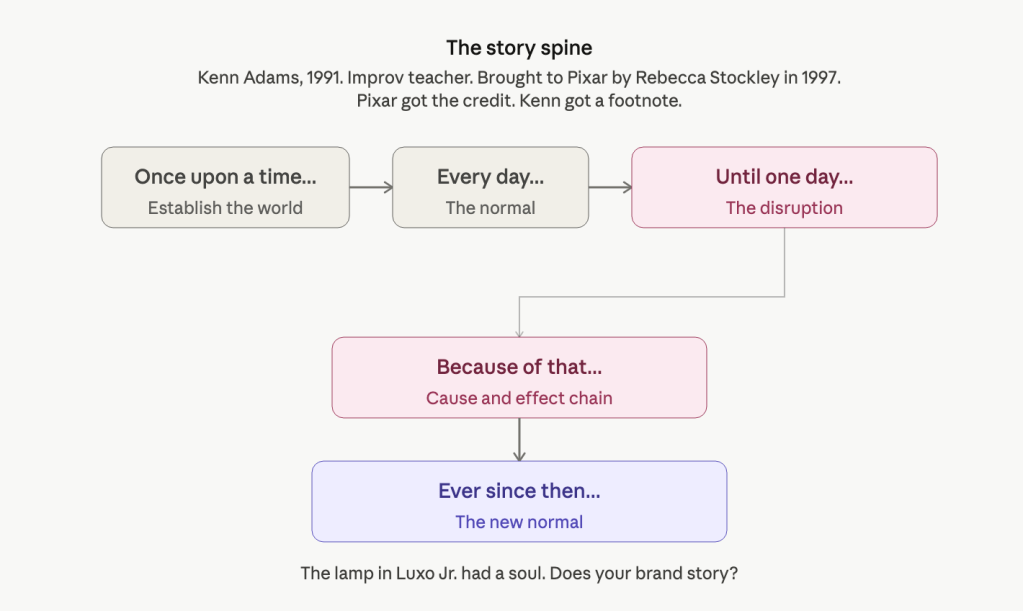
It is also now overused in corporate storytelling workshops, which means somewhere right now, someone is staring at a whiteboard trying to find their “until one day” moment. Pixar used it to make you cry about broken toys. But you cried because the toys had a soul, does your story?
Freytag’s Pyramid
Five acts: exposition, rising action, climax, falling action, and denouement, where all of the final conflicts are resolved. It was built for nineteenth-century theatre and is still used today. The falling action part doesn’t feel critical, but it is. After the climax, the story needs space to create the final discoveries for the audience. They need time to connect all of the dots. Rushing into the resolution is how you get endings that feel full of holes. But you must have a message that is worth slowing down for. And with enough meaning to unpack and savour as the story rolls into the resolve.
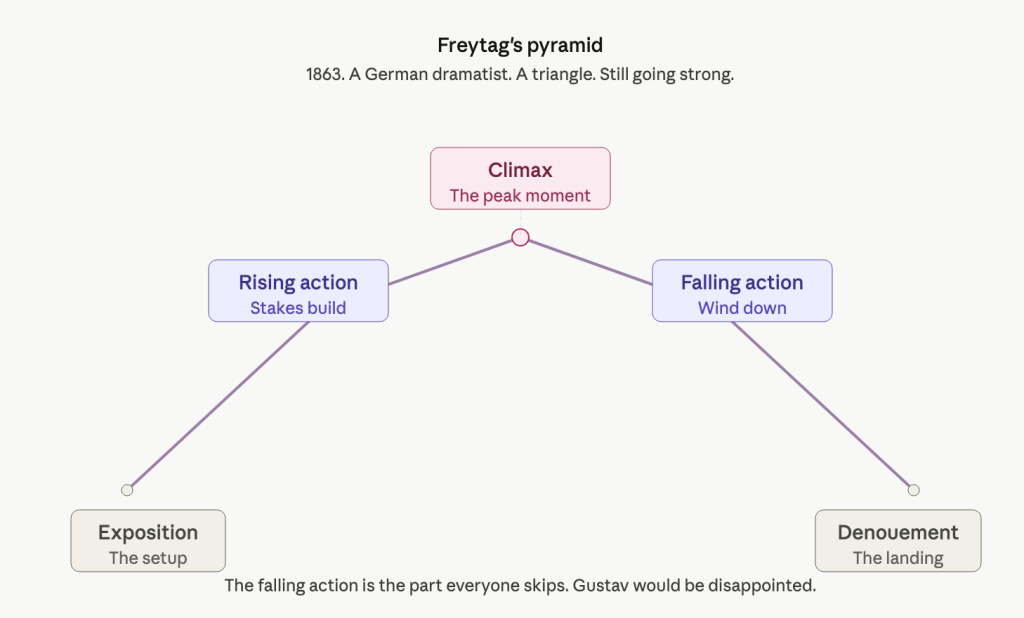
It is a triangle with a roof that is meant to slow the story down. Take into consideration your audience and what you will ask them to consider about your message.
Kishōtenketsu
This four-act structure from classical Chinese poetry has been used across Japanese storytelling, anime, manga and four-panel yonkoma comics for centuries. What is most interesting about it: no conflict. The Ki introduces the world and characters without any problems to solve. The Shō deepens that world, building a connection without crisis. The Ten lands a sudden twist, an unexpected event or shift in perspective that completely reframes everything that came before. The Ketsu ties it together, not with a winner or a loser, but with a new understanding, a sense of harmony or closure.
There is no antagonist or inciting incident. No hero overcoming a barrier. The story is about observing a transformation based on meaning. The audience does not watch someone overcome. They watch someone change.
This structure requires an incredibly strong message to nail the reveal of the transformation.
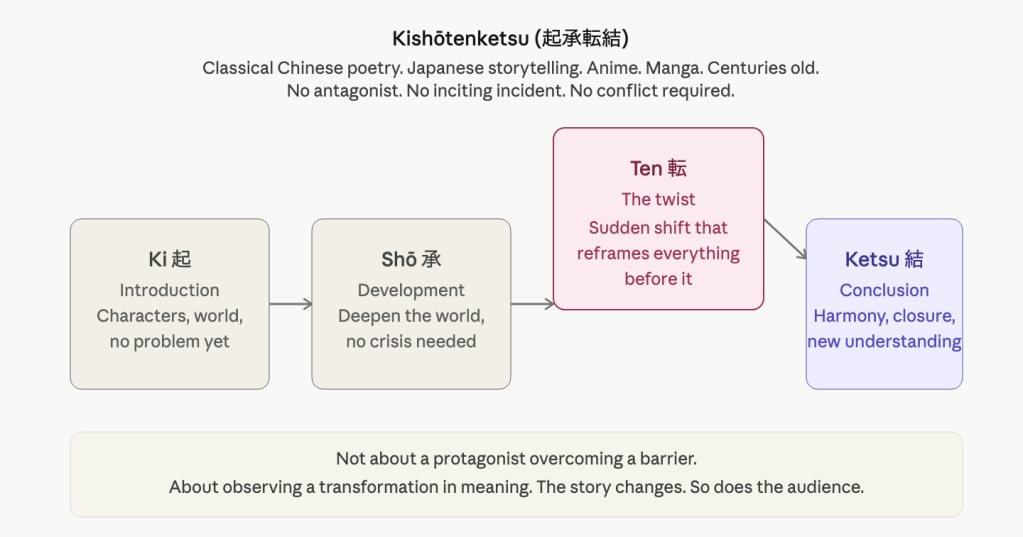
It still needs something real to juxtapose. The twist is the entire point. The chart cannot give you the twist. It is up to the storyteller to provide a real discovery, a meaning that goes beyond plot, cause and effect.
In medias res
Start in the middle. Drop your audience into the action before the first moment of plot arrives. It creates momentum. It trusts the reader to go back in time with your characters and stay with the story until it revisits the middle. When it works, it is electric, the kind of opening that is a perfect hook. The conflict must be related to a meaningful moment. Otherwise, it falls flat and creates confusion. The ‘why’ we should care about the moment must be very clear.
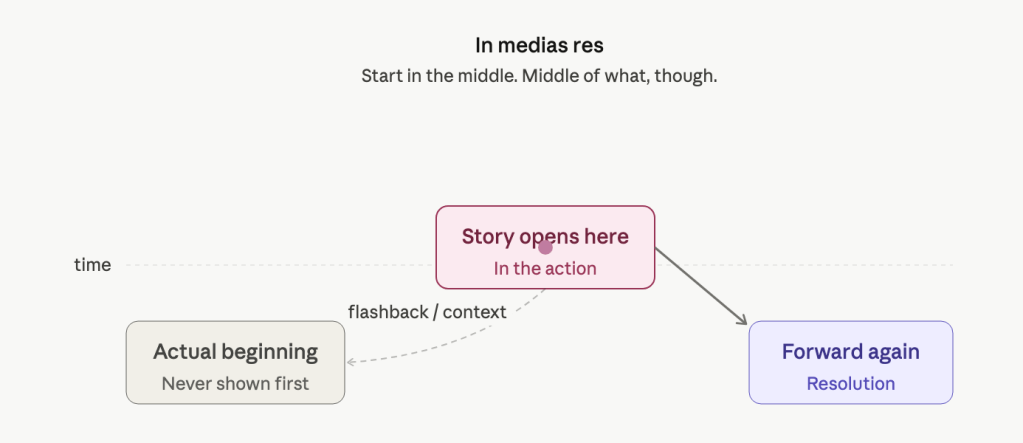
Middle of what, though? Start in the middle of something that matters, and this technique is a rocket. Start in the middle of nothing in particular, and you have created confusion about why they should care about this moment of conflict.
Each structure is a beautifully designed container, but it does not make the meal. You can pour a weak message into a hero’s journey and get a very well-structured empty story out the other side. Meaning trumps structure. Without a clear message of what your story is about on a real, connected human level, there is nothing for your structure to hold up.
The thing that actually works
Here is my fill-in-the-blank formula that focuses on creating a clear message:
My story is about [noun: a person, a place, a thing] and what is interesting about it is [a reveal your audience has not heard before, that makes them think: yes, that is true, or yes, that is about me].
The noun is the simple part. The reveal is a more complicated process.
To break things down a bit more, ask: What are some specific lessons that life has taught you? What have you done? What do you understand from your unique life that contains a beautiful nugget of truth that you must pass on?
Here is a sample story from my life –
I did not always know I was allowed to be a multi-hyphenate. For a long time, I thought you had to pick one thing and be excellent at it. In my previous career, I had to decide between being a photographer or a designer. Or because I had started a business, I needed to write a business book and let go of writing fiction novels. Pick one and choose carefully.
In the first part of my life, I was on stage or auditioning almost every day from the age of 8 to 24. And then I took a very long break. I started a business. I needed to focus on it. I could not afford to be distracted. And I did run that business until one day I noticed an audition notice on Facebook. I stopped scrolling. My finger hovered over the application button. I made a decision, I was going to act again.
I signed up for my first audition in almost fifteen years.
It was on a hot Melbourne summer day in a large shady backyard in Brunswick. I waited in a lawn chair until my name was called. The director and his assistant asked me to arrange the audition space in a way that made me feel comfortable. I said I was fine and ready to go. Even though I did not feel fine. I was covered in cold sweat despite the heat, and my mouth was super dry.
I looked up, and a rage-filled monologue exploded out of me. The director burst out laughing, which was fine. It was a comedy. They asked me to read from one of the plays they were going to produce the next year. I did a cold read audition. I could not remember the last time I did one of those.
The director motioned for me to sit in a nearby chair. He was dressed in loose, flowing clothing and a paisley headband.
“So why do you want to join our company?”
“I love acting, and I want to do it again.”
I revealed that it was my first audition in 15 years. He sat back in surprise. After a brief chat, he said thank you and I will be in touch.
I got the part. And I changed.
Not about acting. I started to see that all of the different jobs I had done in my life were not separate; they were a tapestry. Each skill builds on the others. And most amazingly, I found that being a better actor makes me a better business owner. Skills like being open to what happens, listening carefully to dialogue and working harmoniously in a large cast are skills that make you better at living life in general. I saw that my photography trained my eye and shaped my of design work. Writing fiction makes me sharper at narrative strategy. The layers do not compete. They compound.
That is a story with a reveal. It is not three acts. It is not a hero’s journey, although you could map it onto one if you wanted to. The shape is irrelevant. What matters is that the message is true. Identity is complicated. We are not one thing, and the attempt to be one thing can cost us a lot.
Someone reading might be trying to pick a lane right now. And maybe that story helped.
The test
Let’s go back to finishing this sentence:
My story is about [noun] and what is interesting about it is [reveal].
Fill in the second half that makes you think: yes, I understand that now, or yes, that is true, or yes, I have never heard it put that way. You have a story worth telling.
If you cannot finish the sentence, no framework will rescue you. So just keep going until you have something to pour into that framework.
The chart is a comfort blanket. It makes you feel like you have a plan. The plan is not the story. Go find a message with truth. Then have a look at any structure and give it a shot. Try a couple. Your story will work with any of them if your message is strong.
Go forth, build your message, tell your story.
Go well, dear storyteller. Go well.

