How to Discover Your Inner Narrator for Business Success

You are the narrator; this is your strategy. I work with clients to help them discover their narrative for business or personal purposes. This means they must become the narrator. It starts with a conversation that explores your story, and I start asking questions

Why Change Communication Fails (And How to Make It Stick)

I was working on a digital transformation project for a large bank. My job was to create the roadshow content and the deck that would go out to employees explaining the change process. I was talking to one of the lead engineers to help me understand the ‘why’. Why this change? What would we gain? What would we lose if the change wasn’t implemented? He didn’t have an answer. He responded, “The CEO just decided. That’s why.”

From Survey to Community Intelligence: A New Approach to Conference Insight

Conferences are not selling satisfaction. They are building something harder to measure and more valuable: belonging, connection, intellectual momentum. Post-event surveys were designed for product testing and customer service. Their job is to measure satisfaction: did the event meet expectations, what would you score it, would you recommend it to a friend? An experience that makes someone fly interstate for three days, sit in a room with 300 people they mostly don't know, and leave feeling like their work matters.

Conference Organisers Are Storytellers

From the venues, to the speaker curation, to the way sessions are sequenced and the moments designed into the breaks, these aren't logistics decisions. They're narrative decisions. They shape how people experience the event, what they take away, and what they tell others afterwards.

Am I Good at Telling Stories?

Roughly 80% of our daily communication is some form of storytelling. Not epic novels or keynote speeches. Small moments of your day, fragments of thoughts or anecdotes that illustrate a point of view. We toss around messages embedded in a story in meetings, conversations, and Slack channels. We are telling stories all day, every day, because that is how we understand each other and absorb information. It is how humans are wired.

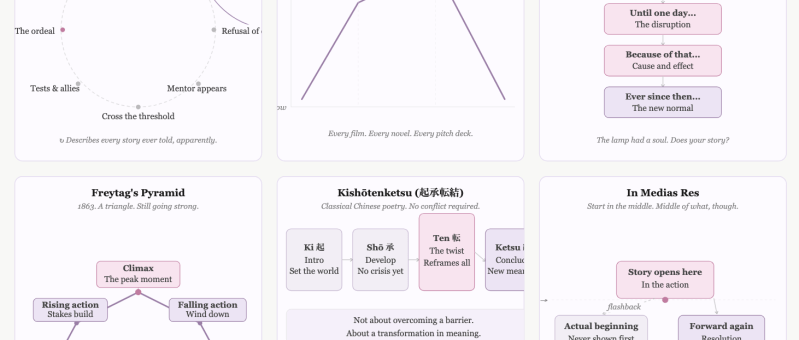
Structure Won’t Save a Story With Nothing to Say

On storytelling frameworks, a Hollywood sequel, and the thing that actually makes stories good. Think of the last movie you saw that made you cry. Or gave you a moment of validation or taught you something new. That moment in the film felt validating and real because a truth resonated with you. Let’s dive into…

Stop Waiting for Inspiration. Start Telling Better Stories.

People working in communications, content, and marketing are thinking about their value. AI can produce copy quickly. Suggest your next strategic move or find holes in your comms plans. It is fast, reliable and never misses a deadline. Where does storytelling training fit into a world where everything that is known about the tricks of the trade of communication is still in an LLM? Why learn about or upskill in storytelling when it is all there for us to explore?

The Best Work Happens When Ideas Feel Safe Enough to Misbehave

I have facilitated numerous workshops, strategy days, narrative sessions, and conference experiences. Regardless of the setting or participants, a consistent pattern emerges. Typically, the most senior, outspoken, or confident individuals are the first to contribute, filling the room with their perspectives. However, as the session transitions to deeper reflection, it is often a quieter participant who introduces a profound idea, causing everyone to pause and absorb the insight.

If Culture Eats Strategy for Breakfast, Then Narrative Is the Cook

At the end of a period of strategic thinking and planning, I normally hear from leaders who want a narrative strategy. When they start managing the process of rolling out the strategy. They ask to tack stories onto the strategy. But this is not ideal. The stories should be embedded in every step of the process. From listening, collecting, collating, and activating your narrative. Especially now, in this time of convergence of changes. AI is reshaping how work gets done. Instability is rewriting assumptions about markets, supply chains, and workforce planning. People are carrying personal disruption into professional spaces in ways that are hard to ignore. Change is not arriving from one direction. It is arriving from everywhere at once.