
 Written by
 People working in communications, content, and marketing are thinking about their value. AI can produce copy quickly. Suggest your next strategic move or find holes in your comms plans. It is fast, reliable and never misses a deadline. Where does storytelling training fit into a world where everything that is known about the tricks of the trade of communication is still in an LLM? Why learn about or upskill in storytelling when it is all there for us to explore?
Because the last story you heard that truly resonated with you and left a lasting impression was not written by a machine.
Show Up Every Day
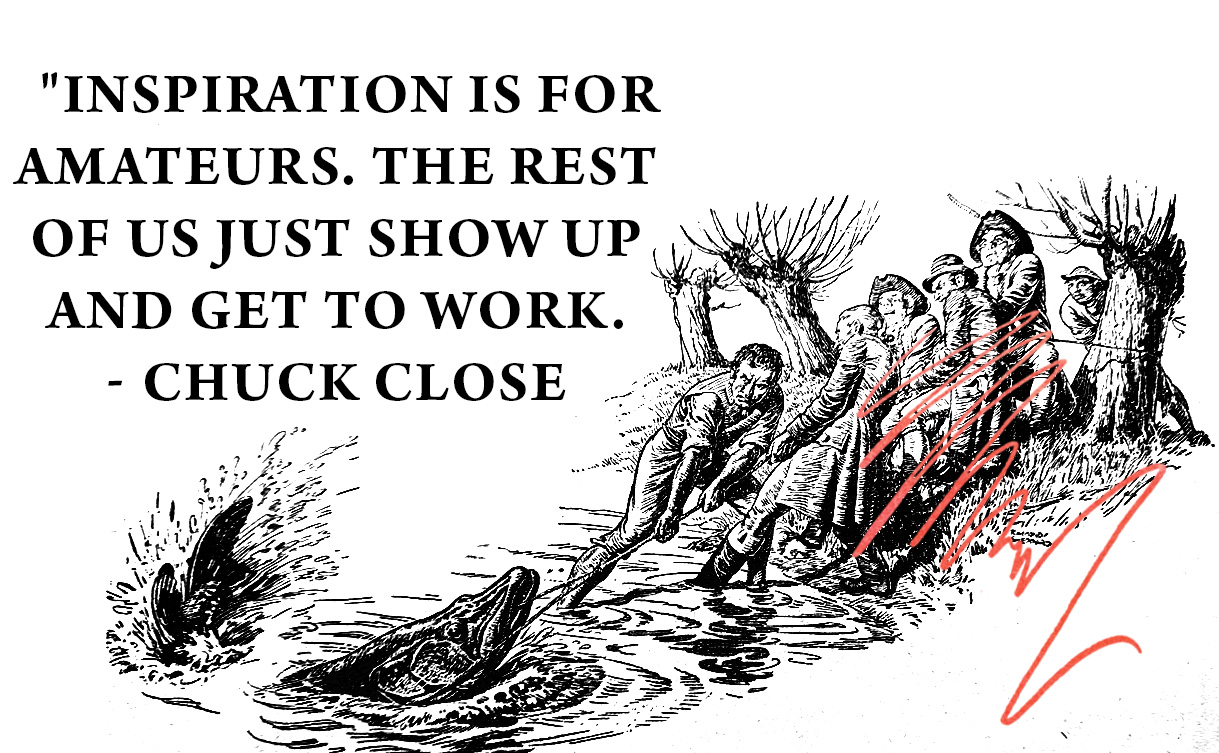
Painter Chuck Close said, “Inspiration is for amateurs. The rest of us just show up and get to work.”
When I train people in storytelling, I explain that it is a practice. Not a skill or a talent. It is something we do every day with the intention of learning more about how it is done or how it works. It is not a talent we are born with. It is not a skill we master before moving on to the next one. It is a practice that apply everyday. We will learn more and more every day. And we cannot wait for it to inspire us into action. We just do it. Practice it every day until our last breath. This is how we as humans communicate.
In communications, showing up means seeing, learning and exploring before writing. You must find the message before you write it. Search beyond questions like “what do we want to say?” and replace them with “what does our audience connect with?”
The Thinking Is the Work
Crafting a message that genuinely lands is not a production task. It is a thinking task. And the thinking has a structure.
The most powerful tool for this is the empathy map from design thinking. Before you write a single word, you map what your audience thinks, feels, fears, and questions. You consider what they might object to. You build your message around their world, not yours.
This is audience-centric storytelling. It sounds straightforward, but it is not how most organisations communicate. Often, they start with what they want to say and then look for an audience to say it to. Turning that around changes everything. It is the difference between a message that gets ignored and one that opens a door.
When you do this thinking, when you sit in the discomfort of genuinely not knowing what your audience needs before you have figured it out, you are doing work that no prompt can replicate.
Invest in Connection
Connection is a skill, not a talent. Is learned and must be practised. It is an investment that pays off in ways that cannot be quantified.
Effective communication is not about finding the right formula. It is about asking better questions. Exploring empathy mapping. Getting refining core messages, finding the version that aligns with business goals and the beliefs of your audience. Learning to use narrative structure not as a template but as a set of choices.
That refinement is what keeps communication work fresh and real. It is what separates content that people skim from content that feels like a conversation.
The Hacks creators, Lucia Aniello, Paul W. Downs, and Jen Statsky, spoke about this in a recent interview with Kara Swisher. When asked about AI in the creative process, Jen Statsky pushed back on the idea of optimising storytelling. She said that removing the friction, removing the grist, leaves you with nothing. That the struggle is not an obstacle. It is the process.
She is talking about television writing, but she is describing something universal about communication and storytelling.
The Grist Is What Makes It Real
The grist is the part of communications work that AI genuinely cannot do. It is about sitting with a message because it is not quite right. It is the messy first draft. It is the empathy mapping session where you discover your audience is worried about something you had not considered.
Remove that friction, and you get serviceable content that meets a brief. Lean into it, and you get communication.
What the Hacks creators are really describing is a commitment to learning. Not a shortcut, not a tool, not a faster pipeline. A genuine, ongoing investment in understanding how human beings tell stories to other human beings and why it works. Jen Statsky has spent years in the grist of it. So have Lucia Aniello and Paul W. Downs. That accumulated learning is exactly what makes their hook into the human experience. And make us laugh episode after episode.
This applies to anyone communicating in an organisation. The skills that keep your work fresh and real are learnable. Empathy mapping teaches you to step into your audience’s world before you create a communications strategy. Audience-centric messaging trains you to address objections and concerns inside the story itself, rather than in the FAQ’s. Crafting a sticky core message means developing something clear and memorable that your audience carries with them after the conversation ends. And learning to use conflict and narrative structure wisely gives you the tools to engage people rather than inform them.
These are not instincts or inspiration. It is the task of creating a connection. Of communication and storytelling that focuses on audience-first methodologies. The grist of learning, the uncertainty, the reworking, the moments where the message is almost right but not quite, is precisely what makes you better at the work that AI cannot do.
If you are ready to invest in that, I would love to hear from you.

