
 Written by
I was working with a client as they were preparing a big presentation for the executive team. They said I don’t know why I am bothering. “All they ever say is, ‘ Show me the financials. They don’t want to hear a story.”
I told them that was fine. We knew what the exec team wanted to hear, so we put the financials first.
But you still need a story. You can’t put up a slide and say nothing. We have all seen a presenter do that: ‘The numbers tell the full story’. No, they do not. Numbers need context. You also have a point of view to promote. While you show the financials and explain them, the story provides much-needed insight and context.
This was the inspiration behind my One Big Idea presentation format. It gives you the constraints you need to build a clear pitch deck and get your idea across the line.
That said, busy people don’t have time for long stories or twenty or even ten slides. I recommend five. Keep them short, simple and to the point.
You might be thinking, this isn’t a pitch; I am not in sales. No one is immune from pitching. We must sell our ideas, secure buy-in, and bring people on board to get work done.
Start with a constraint
In my One Big Idea workshop, I ask everyone to put their laptops away. They grab a pen, a piece of paper, and a workbook. They have twenty minutes to build a five-slide pitch deck using a set of fill-in-the-blank prompts.
Why no laptops? Laptops distract us, and they make it easy to keep adding more. Writing by hand is slower; you write less. That is exactly what we want.
I’ll use two examples through the rest of this article so you can see the prompts in action:
- The email inbox. How do we stop the endless flood and make email feel human again?
When you create your own pitch deck, choose a real project you are working on.
How to build your five slides
Each slide does one job. Work through them in order to create a strategic presentation one slide at a time.
Slide 1: The Big Idea
This is the one message you want people to remember. If they forget everything else, this should stay with them.
I use a simple formula to get there. X is the subject of your pitch. Y is the solution you are proposing. Put them together and you have a key message that sticks.
For the inbox challenge, it might read like this: Email overload won’t be solved by better filters; it needs a more human way of communicating.
Then ask yourself one question. Does this matter to the people in the room?
Slide 2: The People
Name the person your pitch will help. Who are they and what do they need? What do you know about their daily lives?
This is also where you plan for pushback. People can resist a new idea at first. It is important to show them: ‘What is in it for me? ‘
In Made to Stick, Chip and Dan Heath tell us to spell out the benefit of the benefit. They use an old marketing line, often credited to Harvard professor Theodore Levitt. People don’t really want a drill bit. They want the hole, so they can hang their children’s pictures on the wall.
The drill bit is the feature and the hole is the benefit. The pictures on the wall are the benefit of the benefit. That is what people actually care about.
The Heaths explain that your audience is always asking what is in it for them. A strong pitch answers that question before anyone has to ask it.
They also warn us about a trap they call the Maslow basement. We often assume other people only care about the basics, like money and security. Yet we see ourselves as driven by bigger things, like growth, meaning and doing good work. Your audience is no different, so speak to those bigger needs as well.
Let’s flesh this out for the inbox pitch. The feature is a new way to manage email. The benefit is fewer messages to deal with. The benefit of the benefit is leaving work on time and switching off at night.
This idea sits within the Heaths’ SUCCESs model, which explains why some ideas stick and others die. Sticky ideas are simple, unexpected, concrete, credible and emotional, and they are told as stories. Emotion is the part that makes people care, which is why it belongs on this slide.
For this slide, write three lines:
- Person: who is your audience?
- Resistance: what will make them push back? (This is just for your thinking; do not include it on the slide)
- Benefit: what is in it for them?
Slide 3: The Problem
Now describe the problem your people are living with. Here is a simple template to fill in:
[People] are struggling with [specific problem], which is leading to [negative impact]. Current solutions are [limitations of existing solutions]. Without [proposed solution], they risk [further consequence].
Here is how it looks for the inbox:
Professionals are struggling with overflowing inboxes and constant digital interruptions. This is leading to stress, lost productivity and less meaningful communication. Filters, folders and inbox zero strategies only manage the symptoms. Without a human centred approach to communication, they risk burnout, disengagement and important messages getting lost in the noise.
Back it up with something real. A statistic, a study or a direct quote from research all work well.
For the inbox example, use Microsoft’s 2025 Work Trend Index. It found the average worker receives 117 emails a day and is interrupted every two minutes by a meeting, email or message. As the report puts it, these small notifications “can set a frenetic tempo for the day ahead.”
Once you have your problem statement, bring it to life with a story. The statement tells people what is wrong. The story shows them why.
Choose one person who is living with the problem. Describe a real moment from their day. What happened, how did they feel, and what did it cost them?
For the inbox, it might sound like this. Priya opens her laptop at 8am to 142 unread emails. By lunch, she has answered thirty and missed the one from her biggest client. She leaves the office late and still feels behind.
A moment like this makes the problem feel real. Your audience stops seeing a statistic and starts seeing a person. Once they care about that person, they will want to hear your solution.
Slide 4: The Process
This slide illustrates how your solution works. Walk your audience through it one step at a time. Aim for three, no more than four steps.
Add one statistic that supports your approach. One strong statistic is better than adding more noise to the slide. Keep it as simple as possible.
For the inbox, your three steps might look like this:
- Batch your email. Check your inbox at set times, three times a day, and close it in between.
- Turn off the pings. Switch off notifications so new messages wait until you are ready for them.
- Write fewer, clearer emails. Lead with what you need, and pick up the phone when a thread runs past three replies.
- Evidence. A University of British Columbia study asked 124 adults to check email only three times a day for one week. During that week, they reported significantly lower daily stress than when they checked as often as they liked.
Slide 5: The Future
Bring the new world to life with a story. What does it look like once your idea is working? How does it feel for the people you named on slide 2?
Resist the temptation of listing outcomes. Pick one person and show us their day after the change. Storytelling is the most powerful tool you have to engage a room, so use it.
For the inbox, go back to Priya. It is three months later, and she opens her laptop at 9am. She spends twenty minutes on her inbox, then closes it and gets on with the work that matters. Her biggest client gets a phone call instead of another long email thread. At 5:30, she shuts the laptop and doesn’t open it again until morning. She still gets plenty of email, but it no longer runs her day.
Put it on a Story Ring
Once your five slides are drafted, map them onto a circle. Your key message sits at the top. People, Problem, Process and Future sit around the edge.
The ring makes sure every step leads back to your main message. Each slide should show your audience why that message matters. By the time you reach the Future, you have brought them full circle. Your key message lands again, and this time it is stronger.
If one step drifts away from your message, rewrite it until it leads back.
Here is how the inbox looks on a Story Ring:
- Key message: Email overload won’t be solved by better filters; it needs a more human way of communicating.
- People: Professionals like Priya, who spend their day reacting to their inbox.
- Problem: 117 emails a day and an interruption every two minutes, leading to stress and missed messages.
- Process: Batch your email, turn off the pings and write fewer, clearer messages.
- Future: Priya leaves on time, her client gets a call, and her evenings are her own again.
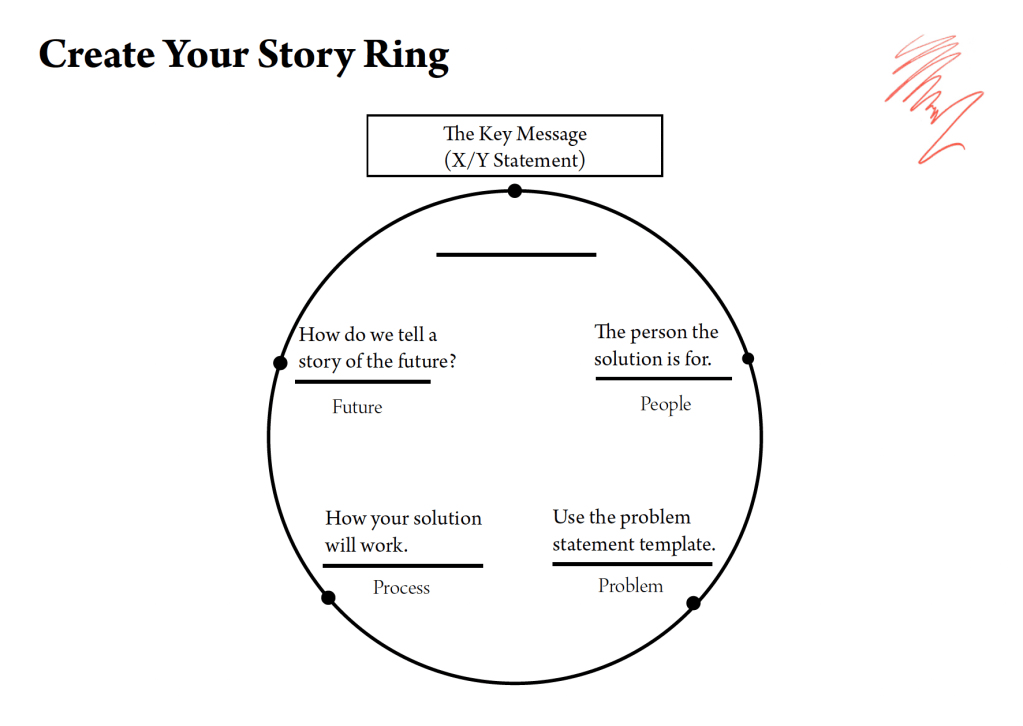
Every point leads back to the same message. Better filters won’t help Priya, but a more human way of communicating will.
Test it out loud
In the workshop, everyone pitches their five slides to the people next to them. Then the listeners say back what they remember.
If the listeners can repeat your key message, your pitch is working. If they remember a detail but miss the main message, go back to slide 1 and start again.
Keep the delivery simple too. Don’t overload people with information. Use strong images and clear type. Make eye contact and let your body do some of the talking.
Clarity comes from the constraint
Let’s revisit my client and the exec team who only wanted to see the financials. We put that slide first and made it the Big Idea.
We used the X Y formula. X was the subject, which was what we were presenting about the numbers that day. Y was the solution. Together they showed cause and effect, and that became the key message. The other four slides then unpacked the idea, ending with a story that brought the change my client was looking for to life.
The feedback was fantastic. The exec team was impressed by how much was said in so little time. They even asked for the deck afterwards, because it was short enough to quickly review. Less really is more.
Emotion was a critical part of getting the executive time on board. We framed the consequence of not acting on the information that the numbers presented. Heard the phrase, it’s not personal, it’s business. Business is full of emotion. These are your ideas, work and livelihood. Be clear about what your audience should feel about the information you are presenting. Of all the Heaths’ principles, this is the one I agree with most. Emotion is what makes your idea stick.
Go forth, storyteller and change the world with your stories! I can’t wait to see how only five slides will refine your approach to storytelling, pitching and building your career.

