
 Written by
 What AI and Climate Change Teach Us About Storytelling
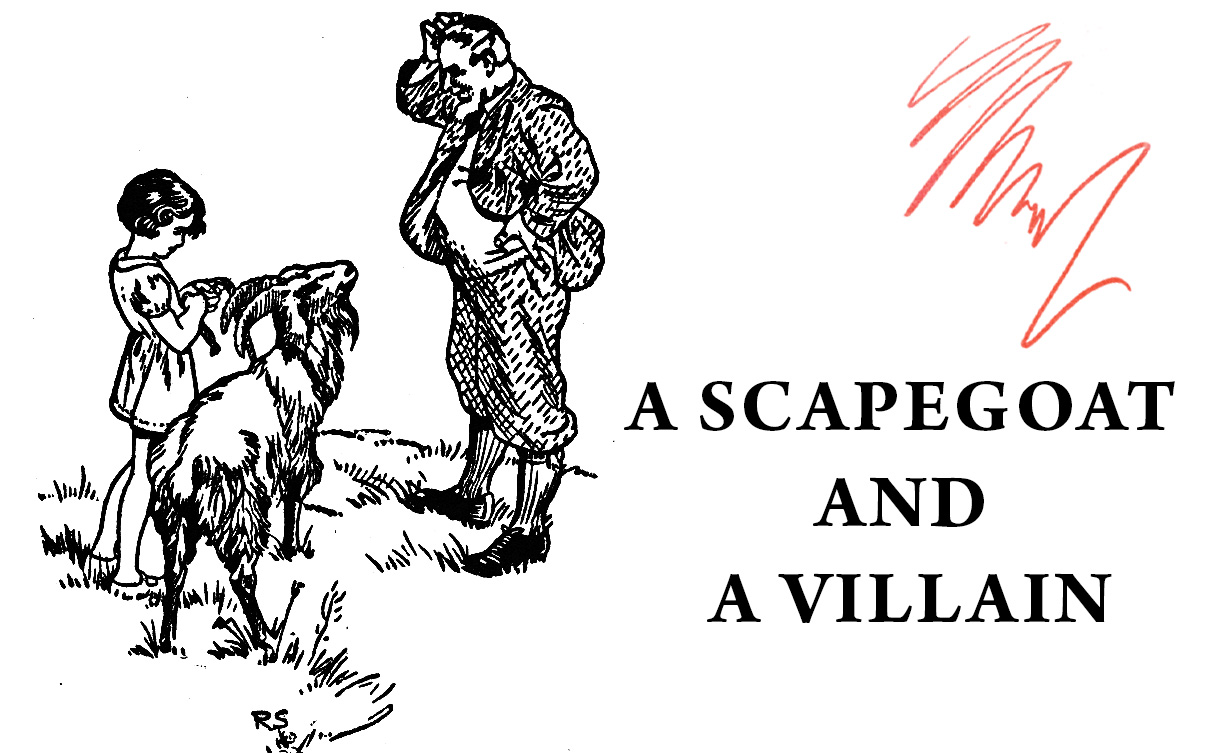
The word “scapegoat” was coined in 1530 by William Tyndale, a Protestant scholar who wrote the first English translation of the Hebrew Bible. In Leviticus 16, he translated the Hebrew word Azazel as a goat that “escapes” to “escapegoat,” and later shortened it to “scapegoat”.
This story in Leviticus is on Yom Kippur, the Day of Atonement; two goats were brought before the High Priest, chosen to be as alike as possible in size and appearance. Lots were drawn: one “for the Lord,” one “for Azazel.” The first was sacrificed. With the second goat, the High Priest confessed the sins of the whole nation, symbolically transferring the community’s wrongdoing onto the animal. It was then driven into the wilderness, carrying those sins with it.
Scapegoating in its original form is a purging: an offloading of the community’s sins onto something else, which is expelled along with the guilt. The practice of transferring sins is universal to human experience. Hence the word ‘scapegoat’ hasn’t fallen out of use in 600 years.
The question is why? Why do we need someone or something to project our failures or guilt onto? Luckily for me and you, dear reader, there are researchers and scientists who have been asking the same question.
What they have found indicates something uncomfortable about which problems we choose to fight, and the ones we think can’t be won. Before I get into the research, let’s look at two major issues affecting humanity right now.
Two threats: one feels imminent, one does not
Two threats stand before us; one has a scapegoat, and the other does not.
One is artificial intelligence. It is shaping up to be a defining issue of the next US election; governments across the world want to regulate it, and the people who build AI have issued warnings that their products could one day kill millions. This is an urgent problem affecting us now.
The other is climate change. In its September 2026 Limiting Overshoot report, the UN stated for the first time that the world will pass 1.5°C of warming within the next few years. The Paris target now looks impossible to meet. But as the report says, with work we can still minimise the impact and pull temperatures back down if emissions fall fast enough.
The impacts of climate change are being felt directly today. July 2026 tied with July 2024 as the planet’s hottest July since record-keeping began in 1850. August 2026 was the joint-warmest month ever recorded globally, tied with July 2023.
If we look at the headlines, the dominant themes are AI and data centres. This feels immediate and is influencing the midterms in America and governments around the world to act. And climate change still somehow feels far off, a future problem; it’s worse in other countries, and it will affect someone else’s children. When I looked for research on why climate change feels distant or like someone else’s problem, the findings are that the problems themselves are complex and nuanced. But the solution to both problems lies with storytelling.
I Was Wrong
The assumption I began with is that climate change feels distant, and that feeling is what stops us from acting. The research did not back up my thinking; I was wrong.
Psychologists call it construal level theory. Things that feel far away in time or space feel abstract, while things that are close feel concrete and easier to act on. However, when researchers looked for evidence that psychological distance is what stops people from acting on climate change, they found very little. Most people understand climate change is real, happening now, and directly impacts their lives. When experimenters framed the damage as local rather than global, it did not move anyone to act. Despite being directly affected by events such as fires and floods, their support for stronger environmental regulations did not increase.
So what does move people?
It’s naming the cause or, dare I say, a villain.
Researchers followed people across England and Wales who lived through floods and heatwaves. Their direct experience, on average, didn’t motivate them to support climate change policies or engage in climate-friendly behaviours. The negative impacts of climate change on their lives weren’t enough.
But there was something that did make a difference. The people who lived through both the 2018 and 2019 heatwaves changed their behaviour to support climate initiatives. The researchers are clear about why: these people’s media coverage of the heatwaves specifically named climate change as the reason for the heatwaves.
A second UK study of the 2013 and 2014 floods showed how the floods impacted people’s feelings of safety living in their homes. Only the people who understood the link to climate change went on to engage in climate-positive actions. Naming the cause is what motivated action. This goes beyond Britain too: a 2025 study spanning 68 countries and more than 70,000 people found the same thing. It’s the people who attribute extreme weather to climate change who support climate policy, not simply the people who have been affected by it.
The villain enters the story
A flood on its own is just bad weather. It’s just something that happens occasionally. But when it is named as climate change, it stops being a fluke or a once-in-100-year event. It has a direct cause. It becomes part of a story, with *drum roll*, a villain. This is the catalyst for action.
The research on naming a cause or villain is clear: whether someone connects a flood to climate change depends on what they already believed and on the coverage, the person telling the story.
When the news calls a heatwave a weather event, the villain is never named. The audience files it under bad weather and does nothing. It is not part of a larger story of events around the world.
Let’s look at the amount of action being taken on AI. AI’s story has plenty of villains. Every news report names companies, executives and research labs. The culprit is clear. For reasons that are often political climate’s story often does not name the villain. A story with no villain doesn’t motivate an audience.
The most dramatic depictions of the AI threat, where autonomous machines awaken and turn against humanity, subtly shift focus toward the concept of AI and away from the people who designed it. That redirection echoes the ancient impulse to shift blame onto a scapegoat. And yet it fails because the public remains focused on the humans responsible. Ultimately, we like our villains to have a face. In the discussion around AI, a striking consensus emerges: citizens overwhelmingly oppose unchecked AI, and they recognise who holds accountability.
A clear villain bands people together. A fractured public that can’t agree on many political matters seems to be able to band around a named villain, especially one with a face. A cause needs a villain. A villain is the plain truth about who is responsible, stated plainly so people can act on it.
The villain and the scapegoat
Do we need a scapegoat to carry our sins into the wilderness?
Researchers have shown that when people are reminded of their own part in climate change and then handed someone else to blame, their guilt disappears. The scapegoat carries the discomfort away.
This is the true dilemma climate change presents. While it can be clearly identified, it fails as a convenient scapegoat because we are active participants in the narrative. Climate change does not isolate a distant wrongdoer; it confronts us with our own actions. The flights we book, the fuel we consume, and the homes we heat. Without an external entity to bear the blame, we are forced to recognise that some of the responsibility lies with ourselves.
AI as a villain is a company, an executive, a lab, someone we can be furious at, pursue and hold to account. We never have to point the finger at ourselves. In this instance, there is a clear villain that isn’t us.
Climate change has never felt far away. It’s that the story refuses to let us off the hook. And a villain where we might also share in the blame is uncomfortable.
That’s what the research points to. We don’t always choose the fights that matter most. We choose the ones where we get to be the hero.
So how do we use this?
Viewing the villain as an essential tool rather than a cheap shortcut allows us to deploy it deliberately and effectively. Driving action requires combining the villain and the scapegoat, each serving its own purpose.
The villain creates clarity. It names something that turns a vague threat into a problem you can act on. The research says if you don’t name climate change, people never make the link, and they don’t act.
The scapegoat releases the individual from fault. It is not merely confusion that immobilises people, but guilt. Climate change’s villain can cause paralysis because it turns the focus back onto ourselves. Utilising a scapegoat acknowledges that we remain part of the equation, but the vast majority of the climate issues we are experiencing today came from actions taken long before our time. Working collectively, we can now generate a cumulative impact in the opposite direction. Rather than absolving anyone of responsibility, this approach relieves guilt to enable people to take action.
Using these tools together creates momentum. A clear villain so people know where to look, and a scapegoat so they don’t buckle under their own guilt. That is how a story creates change.
The AI villain is clear: the companies, the data centres, the executives. The story is reinforced every time someone who helped build these systems says we have to slow down. Is there a scapegoat as well, despite the clear villain? Plenty of people who use AI still want to regulate it. The blame is not on the user, but the builder. We get to keep using it and still demand to rein in the harm. Villain for clarity, scapegoat for relief.
Where’s the villain in your story?
How do we apply these concepts to a sticky problem you are trying to solve?
Imagine your internal comms campaigns with a villain: the market shift that is coming for us, the disruption to our industry, the competitor on our heels.
A difficult quarter becomes far easier to handle when framed around a scapegoat. Communicating a drop in performance not as an individual failure, but as a shared challenge. For example, revenue slipped because 18 months of rising costs finally caught up with your customers, and they pulled their spending. The numbers didn’t fall because people stopped trying; they fell because the market tightened around all of us, and we must work together to solve it.
Now a final question. Where in your own work is there a story that requires action? Where is the villain in your story, and where is the scapegoat that will make people feel secure enough to act?
The villain + the goat that lives
Remember in our story about Yom Kippur, two goats went before the priest. One was sacrificed. The other that carried the sins of the nation was not. It was set loose into the wilderness alive.
The goat is still carrying sins. The community can keep transferring the guilt across; it survives to carry them.
Your scapegoat must carry real troubles on its back. Actual market conditions, business hurdles, workforce concerns. Once the troubles are named don’t let it go. Keep it alive. Bring it back every time you need it. The funding that shrank, the costs that climbed for your customers, the market conditions that aren’t favourable. This is not a sacrifice, gone forever. A scapegoat is alive, the through line that holds the story together. The more cohesive your story, and the further it can travel.
Name your villain. Focus on what you are working against. And then free your goat. Whatever you do, don’t lose sight of it as it wanders off into the wild, because you are going to need it again.
Sources
The research and reports behind this piece:
- UN crosses 1.5°C: UNEP, Limiting Overshoot (September 2026). https://www.unep.org/news-and-stories/press-release/unep-world-set-cross-15degc-global-warming-can-still-limit-adapt-and
- Record temperatures: Copernicus Climate Change Service, on the 2026 heat records. https://climate.copernicus.eu/copernicus-august-was-worlds-joint-hottest-month-record-pushing-global-temperatures-back-above
- Psychological distance: construal level theory, developed by Trope and Liberman. Overview: https://en.wikipedia.org/wiki/Construal_level_theory
- Experience raises risk perception but not behaviour, with the 2018/2019 exception: Lohmann and Kontoleon (2023), Do Flood and Heatwave Experiences Shape Climate Opinion?, Environmental and Resource Economics. https://link.springer.com/article/10.1007/s10640-023-00796-0
- Attribution is the necessary link: Ogunbode, Demski, Capstick and Sposato (2019), Attribution matters, Global Environmental Change. https://www.sciencedirect.com/science/article/abs/pii/S0959378018302693
- Attribution predicts policy support across 68 countries: Nature Climate Change (2025). https://www.nature.com/articles/s41558-025-02372-4
- Blaming a scapegoat reduces our own climate guilt: Journal of Experimental Social Psychology (2013). https://www.sciencedirect.com/science/article/abs/pii/S0022103113001017
- Origin of the word scapegoat: Sydney Jewish Museum. https://sydneyjewishmuseum.com.au/jewish-culture/the-origins-of-the-scapegoat/

